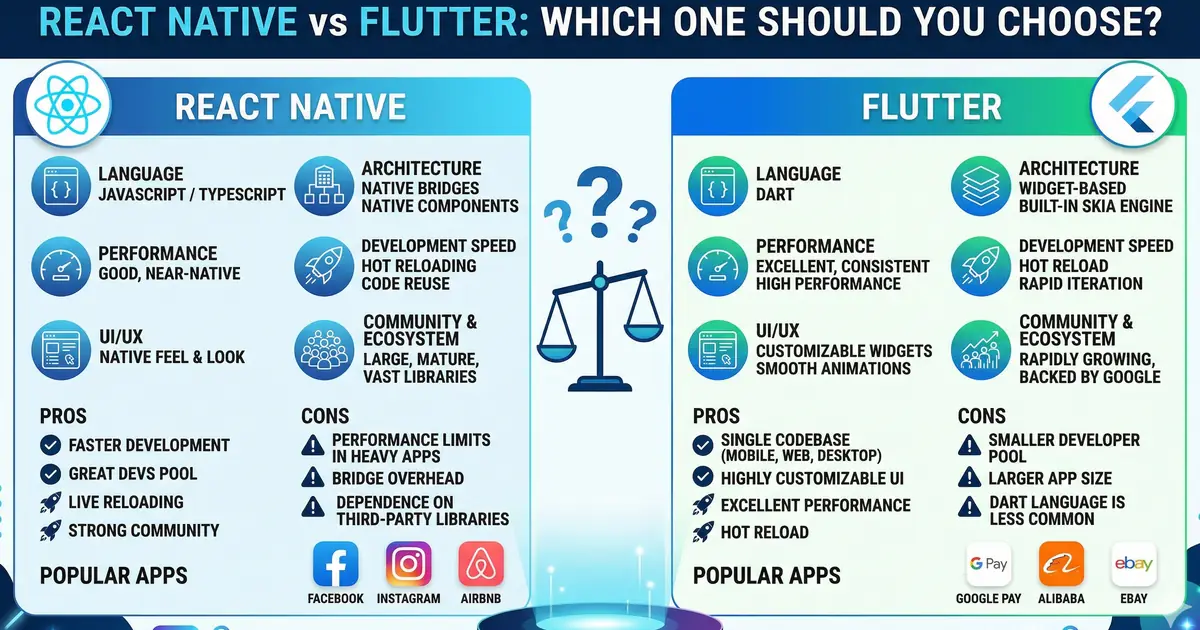
A business-focused comparison of React Native and Flutter based on budget, timeline, and team goals.
Choose React Native if your team utilizes JavaScript/React and web integrations. Choose Flutter if pixel-perfect uniform UI and complex graphics are required. Both deliver cost-effective cross-platform iOS and Android apps.
Both React Native and Flutter are excellent choices for cross-platform mobile apps, but the right option depends on your current team and business priorities.
React Native is a strong fit if your developers already work with JavaScript and React. It can reduce onboarding time and speed up development in teams with web experience.
Flutter offers highly consistent UI across devices and gives strong control over design. Many teams prefer it for apps where custom visuals and smooth animations are a top priority.
From a business point of view, both can reduce cost compared to building separate native apps for iOS and Android. The key is choosing the stack your team can maintain confidently long-term.
Before deciding, evaluate hiring availability, release timeline, third-party integrations, and expected feature complexity. A good technical decision is one that remains sustainable after launch.
The best framework is not the one with the loudest hype; it is the one that aligns with your product roadmap and team strengths.
Related Services and Resources
Frequently Asked Questions
Is React Native faster to build with than Flutter?
If your team already knows JavaScript and React, React Native typically offers faster development velocity and easier component reuse from web codebases.

Zameer Ahmed Mehsood
Author & Solutions ArchitectFull Stack Developer and AI Solutions Architect building high-performance Next.js applications, custom AI automations, and SEO-optimized software for businesses in Pakistan and worldwide.